
Reflections on Eternal Truths, Conscience, and the Danger of Rules Over Grace.
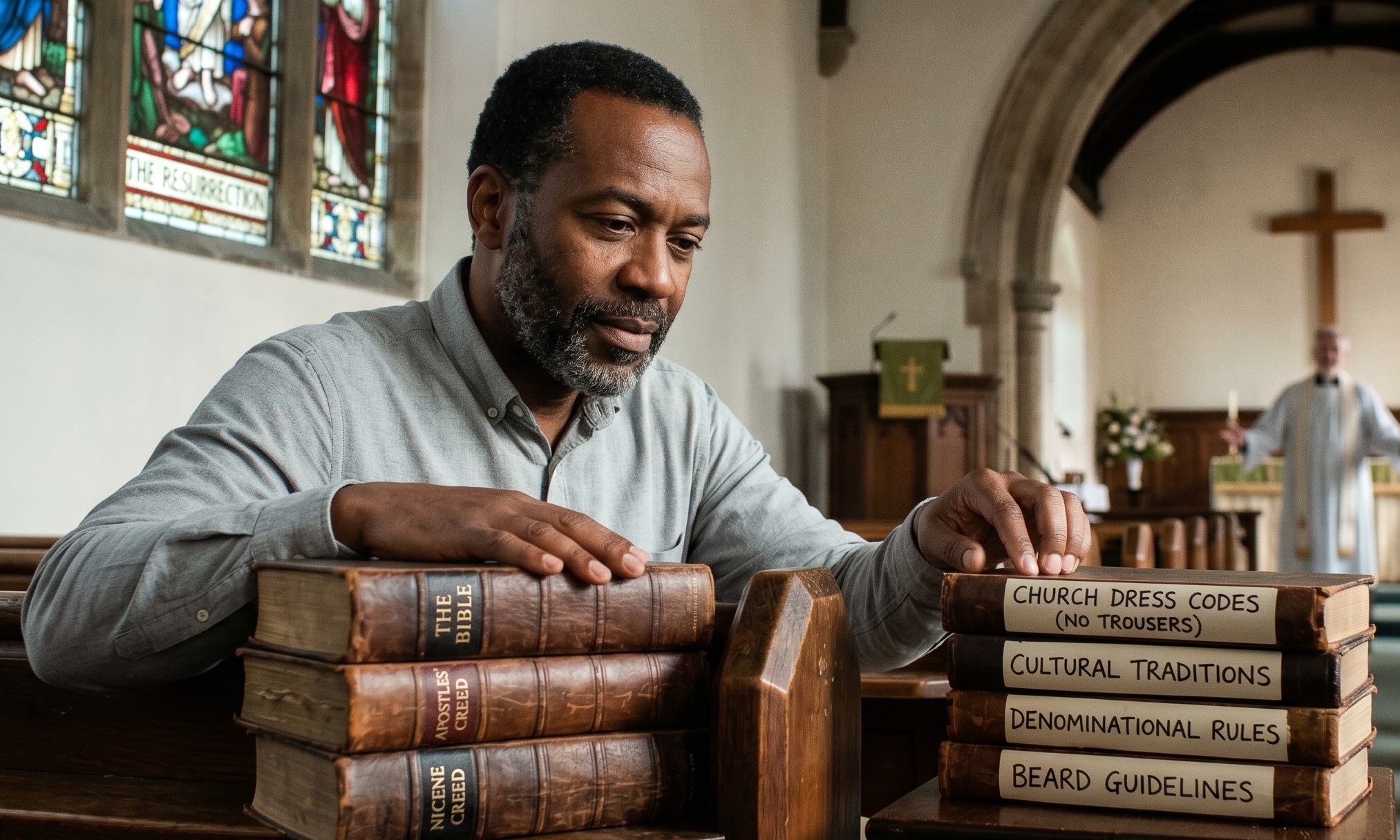
Biblical truth is eternal. Its cultural applications are not. That single distinction, properly understood, could spare the church enormous damage, restore broken relationships, and rescue the faith from the reputation it has earned in too many households for being more concerned with rules than with people.
I have lived on both sides of that damage. I was born into the Catholic Church. My mother eventually found her way to the Watchman Church after my father died, not because she had done a theological survey and concluded it was doctrinally superior, but because they showed up for her when she needed it most. People naturally gravitate toward the community that extends a hand in their darkest moments. I understood that, even when I did not agree with it. I remember going to the Catholic Church alone one Sunday after my family had left for the new one. My cousin applauded me. She was firmly pro-Catholic then.
Years later, one of my closest childhood friends told me he would not attend my wedding ceremony, only the reception. He refused to enter a Pentecostal church, not even for the wedding of someone he had known his whole life. That is how serious these things had become.
All of it, the friction, the broken fellowship, the refusal to walk through a church door for a friend traced back to a failure to distinguish what is essential to the Christian faith from what is not.
What the Essentials Are
There are things all Christians can agree on. The Apostles' Creed and the Nicene Creed - confessions that have defined Christian orthodoxy across centuries and denominations establish them plainly: the birth, death, and resurrection of Jesus Christ; salvation through him alone; the Triune nature of God: Father, Son, and Holy Spirit. These are not denominational preferences. They are the load-bearing walls of the faith.
Paul makes this explicit in 1 Corinthians 15:3-5: "For what I received I passed on to you as of first importance: that Christ died for our sins according to the Scriptures, that he was buried, that he was raised on the third day according to the Scriptures." This is the gospel. Everything else: the dress codes, the worship styles, the church governance structures, the cultural customs exist downstream of this.
In Romans 14, Paul addresses the early church's disputes over food offered to idols and the observance of certain days. His counsel is instructive: "Accept the one whose faith is weak, without quarreling over disputable matters" (Romans 14:1). He does not say that all positions are equally correct. He says that on disputable matters, the community must make room for difference without fracture. He distinguishes between the things that define belonging to Christ and the things that belong to the category of conscience and culture.
That distinction between the non-negotiable and the disputable is the one the church has consistently failed to maintain. And the failure is costly.
Two Kinds of Error
It is important, however, to be precise here, because not all disagreements on non-essential matters are equal. There is a difference between a church that holds, say, a particular position on head coverings as a cultural standard within its community, and a church that teaches that women who wear wigs will go to hell. The first is a preference, potentially debatable, but not harmful in itself. The second is a misrepresentation of Scripture that carries real spiritual and material consequences.
Both involve non-essential matters. But one holds them as community customs, and the other elevates them to the level of salvation. That elevation is where the danger lives.
Misinterpreting Scripture creates more enemies than it wins converts. Truth naturally divides, Jesus himself said so (Matthew 10:34). But the misrepresentation of truth does more damage than the absence of truth altogether. It drives people away from God using God's name to do it.
The Trouser Argument
Trousers were not invented for religious reasons. Historically, they were developed by men for practical purposes, horse riding, military service, physical labour. They became a cultural norm, not a divine command. Women began wearing trousers in the twentieth century as they entered factories, military service, sports, and professional environments. It was a practical and cultural shift, not a moral one.
The verse most often deployed against it is Deuteronomy 22:5: "A woman must not wear men's clothing, nor a man wear women's clothing, for the Lord your God detests anyone who does this." The principle here is clear and permanent: the deliberate blurring of gender identity is condemned. But its application must be honest.
In a world where trousers are designed and manufactured specifically for women cut, sized, marketed differently, wearing them is not cross-dressing by any reasonable reading of that text. If a man were to wear clothing designed and intended for a woman, that is a problem. The reverse is equally so. The principle stands. But applying it to women who wear trousers made for women is not faithfulness to Deuteronomy 22:5, it is a misreading of it that substitutes cultural conservatism for exegesis.
Biblical truth is eternal. The cultural forms through which it was expressed in the ancient Near East are not always transferable wholesale into the twenty-first century. To interpret Scripture honestly is to ask what the text was actually commanding and then to ask how that command applies in a world the original author could not have imagined.
The Beard Question
The case against beards is even harder to sustain, because Scripture does not merely permit beards, it treats them as marks of dignity.
Leviticus 19:27 often cited in entirely different debates reflects an ancient context in which shaving the beard was associated with pagan mourning rites. The instruction to Israel to avoid it was partly a call to remain distinct. In 2 Samuel 10:4-5, when the Ammonites shaved off half the beards of David's servants, it was considered such a grave humiliation that David commanded them to stay in Jericho until their beards grew back before returning to public life. A beard was not a sign of worldliness. It was a sign of honour.
Isaiah 50:6, a Messianic text pointing to Christ reads: "I offered my back to those who beat me, my cheeks to those who pulled out my beard; I did not hide my face from mocking and spitting." The suffering servant, in his willing humiliation, had a beard that his tormentors pulled out. It is one of the most striking details in the passage.
My brother visited a branch of his church in the east once after years of being in Abuja and was relegated to the back row because he kept his beard. There were speculations that he might have backslided. I understand that churches may establish standards based on culture and community identity. What I cannot accept and what Scripture does not support is pinning those standards on the Bible as though God commanded them. That is not a minor issue of preference. That is teaching as doctrine the commandments of men (Matthew 15:9), and it is the thing Jesus reserved some of his sharpest rebukes for.
The Danger of Unverified Revelation
A woman once rose in a church and announced that she had visited both hell and heaven and returned with messages from God. Among those messages: women who wore wigs or hair attachments would go to hell.
There was no biblical foundation for this. There was no consistent scriptural witness, no testing against the full counsel of God's Word, no submission to the broader community of the faith. And yet it spread, widely, and with consequences. My mother's clients turned away because people believed the claim. Businesses suffered. Livelihoods were disrupted. Years later, the woman publicly recanted. But who compensates the people whose businesses were destroyed? Who restores what was lost?
Scripture speaks directly to this. "Do not treat prophecies with contempt but test them all; hold on to what is good" (1 Thessalonians 5:20-21). And again: "Dear friends, do not believe every spirit, but test the spirits to see whether they are from God, because many false prophets have gone out into the world" (1 John 4:1). The instruction is not to reject all prophetic utterance, but to refuse to accept it uncritically. Doctrine is not established by one person's vision. It requires consistent witness across Scripture, tested against the whole of God's Word, and weighed by the community of faith.
When church leaders present personal experiences or private instructions as binding doctrine, the result is not conviction, it is confusion. And God is not the author of confusion. As Paul writes, "God is not a God of disorder but of peace" (1 Corinthians 14:33).
Moving Toward Unity
These are not abstract theological debates. They divide families. They ended up as an argument about whether my closest friend could walk through the door of the church where I was getting married. They cost my mother her income for a season. The personal toll of non-essential disputes treated as essential is real, and the church must account for it.
Any conviction you hold that cannot be demonstrated from Scripture should remain personal. It may be meaningful to you, and that is valid. But do not impose it on others, and do not mock those who do not share it. As long as the foundational truth is not compromised, we are called to make room for one another. "Accept one another, then, just as Christ accepted you, in order to bring praise to God" (Romans 15:7).
When you visit or minister in another denomination, wisdom demands that you submit to the culture and authority of that community, provided their rules do not contradict the foundational truth of Scripture. Some Christians make the costly mistake of arriving as guests and immediately challenging the host church's authority. That is not boldness. It is foolishness dressed as conviction.
There is also a posture required of the host. If you are the one holding a preference, if your standard about beards or jewellery or a particular style of dress is a community norm rather than a biblical command, hold it with enough humility to know what it is. Do not force something you made on people in the name of God. Like my friend was forced to shave his beards because he attended a church wedding as the best man to the groom. He was a guest and should have been allowed to stay.
The goal is not uniformity. It is unity, especially on the things that matter most. The earliest Christians disagreed about food, about days, about customs inherited from different cultural backgrounds. Paul's answer was not to demand that everyone agree, but to insist that they handle their disagreements with grace, and that they never let those disagreements obscure the thing that actually bound them together: the death, burial and resurrection of Jesus Christ.
My cousin who applauded me for going to the Catholic Church, years later, have become more rigid about denominational lines after she switched sides. Her position shifted but her mindset remained the same. But at least she is open to associating with people from different doctrinal backgrounds. The friend who refused to come to my wedding, I have not given up on that relationship either but I’m not sure his position has changed.
Love must always lead, not because love is sentimental, but because it is the only force patient enough to hold a conversation together long enough for understanding to arrive.
That is the standard Christ modeled. It remains the standard we are called to pursue.